
Best Mask for Woodworking: Why Professional Furniture Builders Choose the RZM3
Every cut, every sand, every pass through the table saw fills the air with particles your lungs were never designed to handle. For professional furniture builders and serious woodworkers, respiratory protection isn't optional — it's part of the craft. Wood dust, reclaimed lumber debris, varnish fumes, and fine sanding particles are daily hazards in any active woodshop. The question isn't whether you need a mask. It's whether the mask you're wearing is actually doing its job.
This is the most complete guide to respiratory protection for woodworkers and furniture builders available. It covers what you're actually breathing in the shop, what a mask needs to handle it, how to choose the right protection for every task, and why the RZM3 premium reusable mask is the go-to choice for woodworkers who take their craft — and their health — seriously.
Why Woodworking Is One of the Highest-Risk Trades for Respiratory Exposure
Woodworking generates more airborne particles than most people realize — and many of the most dangerous ones are invisible to the naked eye. According to OSHA's wood dust guidelines, wood dust is a recognized occupational health hazard with established Permissible Exposure Limits (PELs). The CDC/NIOSH provides specific guidance on wood dust exposure and respiratory protection for woodworkers. IARC classifies hardwood dust as a Group 1 carcinogen with occupational exposure.
The damage is cumulative and largely invisible until it isn't. Woodworkers who take respiratory protection seriously early in their careers are the ones still working comfortably decades later.
Fine Wood Dust from Sanding and Cutting
Table saws, belt sanders, random orbital sanders, routers, and shapers generate ultra-fine dust particles that bypass your nose and throat entirely and settle deep in your lungs. Particles under 10 microns pass your body's natural defenses. Particles under 2.5 microns (PM2.5) penetrate deep into lung tissue. Particles under 1 micron reach the deepest lung structures and are extremely difficult for the body to clear. Fine wood dust remains airborne for 30 minutes or more after the tool stops — meaning you're still inhaling it long after you've put down the sander.
Hardwood Dust — The Highest-Risk Wood Category
Hardwoods like oak, walnut, cherry, and maple are among the most commonly worked species in furniture building — and among those most associated with respiratory sensitization with repeated, unprotected exposure. IARC classifies hardwood dust as a Group 1 carcinogen with occupational exposure. If you work hardwoods daily, consistent respiratory protection is not optional — it's essential.
Reclaimed Wood: A Hidden Hazard
Reclaimed lumber is prized for its character and history — but it also carries decades of accumulated dirt, mold spores, biological particles, and unknown surface treatments. Sanding reclaimed wood without proper respiratory protection means breathing in a concentrated mix of particles that standard paper masks simply cannot filter effectively. The biological particle load in reclaimed lumber can be significantly higher than in fresh-milled wood.
MDF and Engineered Wood — A Compound Hazard
MDF (medium-density fiberboard) and plywood contain adhesive resins — including urea-formaldehyde in many products — in addition to wood fiber. Cutting, routing, or sanding MDF generates extremely fine dust at high concentrations. For furniture builders who use MDF for cabinet backs, drawer bottoms, and painted components, consistent respiratory protection during MDF work is especially important.
Varnish, Stain, and Finish Fumes
Applying finishes, stains, lacquers, and varnishes releases volatile organic compounds (VOCs) into your immediate breathing zone. In enclosed woodshops with limited ventilation, these fumes accumulate quickly. A mask without active carbon does nothing to reduce organic finishing odors — which is why the active carbon layer in RZ Mask F1 and F3 filters is essential for furniture builders who do any finishing work.
Table Saw Ripping — The Highest Single-Exposure Moment
Ripping wood on a table saw kicks up a concentrated stream of dust directly toward the operator's face. This is one of the most consistent and high-volume dust exposure moments in any woodshop — and one of the most important times to have a properly sealed, high-filtration mask in place. A mask that gaps or slips during this operation is providing no meaningful protection.
What Professional Woodworkers Need in a Dust Mask
A mask that works for occasional weekend projects is not the same as a mask that works for a professional furniture builder putting in full days in an active woodshop. Here's what actually matters — and what most masks get wrong:
A Seal That Holds During Physical Work
Woodworking is active. You're bending over workpieces, lifting lumber, reaching across benches, and moving constantly. A mask that slips or gaps during movement is worse than useless — it gives you a false sense of protection while letting unfiltered air in around the edges. The most important structural element in any woodshop mask is a proper adjustable nose clip and 360° perimeter seal that holds through real, physical work.
Filtration That Captures Fine Particles
Standard paper masks are designed for large particles and do not seal properly against the face. For woodworking — especially with hardwoods, reclaimed lumber, or MDF — you need filtration that captures particles at the sub-micron level, not just visible sawdust. RZ Mask F1 and F3 Active Carbon Filters are designed to filter particles down to 0.1 micron — well below the PM2.5 threshold and far below the size of fine wood dust.
Active Carbon for Finishing Work
Particulate filtration alone is not enough for furniture builders who do any finishing work. VOCs from stains, lacquers, polyurethane, and oil finishes are gaseous compounds that require active carbon filtration to address. A mask without active carbon provides no protection against finishing odors — regardless of its particulate filtration rating.
Breathability for Long Shop Sessions
If your mask makes it hard to breathe, you'll pull it down. That's the reality of respiratory protection in any physical work environment. A mask that prioritizes breathability is one you'll actually keep on through a full day of sanding, cutting, and finishing — which is the only way it can protect you. The RZM3's dual one-way discharge valves actively exhaust heat and moisture with every exhale, keeping the mask interior cooler and drier than masks without discharge valves.
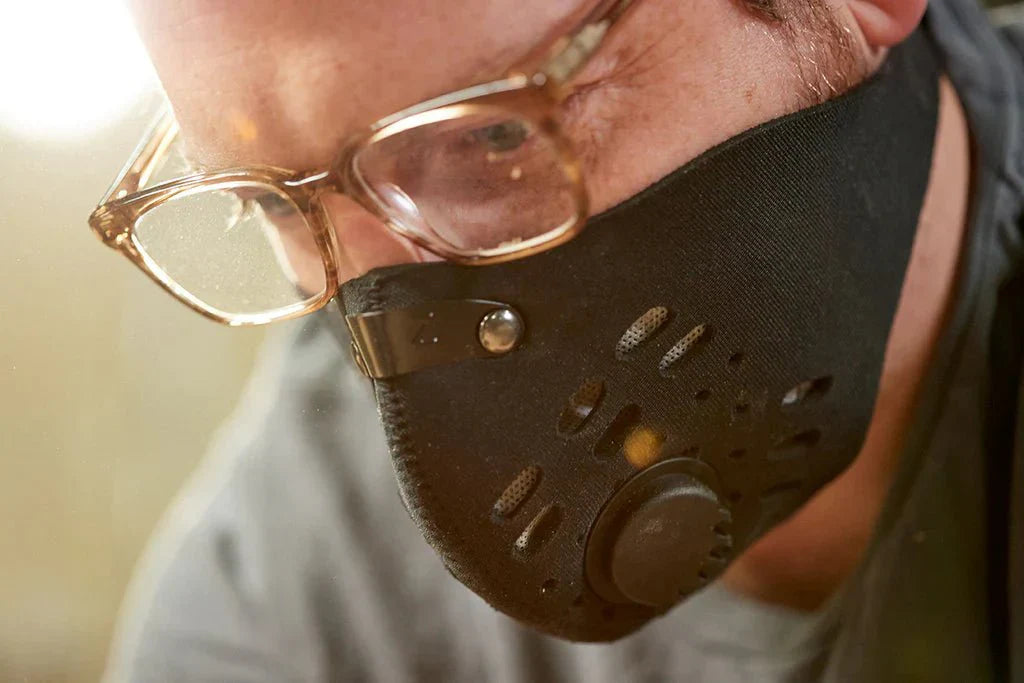
No-Fog Performance for Safety Glass Wearers
Safety glasses are non-negotiable at the table saw, router table, and lathe. But most masks cause fogging that forces woodworkers to choose between clear vision and respiratory protection. The result is predictable: the mask comes down, and the woodworker breathes unfiltered air during some of the most dust-intensive tasks in the shop. A no-fog mask design eliminates that trade-off entirely.
Why the RZM3 Is the Right Mask for Woodworkers and Furniture Builders
The RZM3 three-strap reusable mask was designed for people who work in dusty, particle-heavy environments every day. It meets every requirement that serious woodworkers and professional furniture builders need from their respiratory protection — and it does it in a mask comfortable enough to actually wear through a full shop session.
Filtration Down to 0.1 Micron with Active Carbon
The RZM3's F1 and F3 Active Carbon Filters capture particles as small as 0.1 micron — well below the size of fine wood dust, MDF particles, and biological particles from reclaimed lumber. The active carbon layer is designed to help reduce organic odors from wood finishing products, stains, lacquers, and oil finishes. One filter system that addresses both the particulate and organic odor hazards of a complete furniture building workflow.
Patented Three-Strap System for All-Day Fit
The RZM3's patented three-strap system distributes tension evenly across your face, creating a secure seal that holds through bending, lifting, and active movement. Three configurations — head strap for maximum stability, neck loop for quick on/off between tasks, ear loop for lighter use — adapt to every woodshop scenario. No slipping. No gaps. No readjusting mid-project.
Adjustable Nose Clip and 360° Perimeter Seal
The RZM3's adjustable nose clip is engineered to be shaped precisely to your individual nose profile — creating a complete seal at the nose bridge that holds through active work. Combined with the 360° perimeter seal design, the RZM3 ensures that air passes through the filter, not around it. This is the seal quality that makes the filtration rating actually mean something in real-world woodshop conditions.
Dual Discharge Valves for All-Day Breathability
Dual one-way discharge valves actively exhaust warm, moist exhaled air with every breath out — keeping the mask interior cooler and drier than masks without discharge valves. The result is a mask that's significantly more comfortable for extended wear in hot, physically demanding woodshop conditions. Woodworkers who switch to the RZM3 consistently report that they stop pulling their mask down — because they can finally breathe comfortably while wearing it.
No-Fog Design for Safety Glass Wearers
The RZM3's adjustable nose clip and dual discharge valves work together to direct exhaled air downward and away from your eyewear — significantly reducing fogging compared to masks without these features. For woodworkers who wear safety glasses or goggles all day, this means you never have to choose between clear vision and respiratory protection.
Reusable and Built for Daily Professional Use
The RZM3 is not a disposable mask. It's built for repeated, daily use in demanding environments. Replace the filter as needed and the mask continues to perform — making it significantly more cost-effective than disposable masks for professional woodworkers who work regularly. The mask shell itself can last multiple seasons with proper care.
Best RZ Mask for Every Woodworking Environment
Home Workshops and Professional Furniture Shops: RZM3
For the vast majority of woodworking environments — from home workshops to professional furniture shops — the RZM3 premium reusable mask is the definitive choice. It delivers the filtration, active carbon, seal, breathability, and no-fog performance that woodworking demands in a reusable mask built for daily professional use.
High-Exertion and Extended Sanding Sessions: RZ Airflow
For woodworkers who prioritize maximum breathability during long, physically demanding sanding and routing sessions, the RZ Airflow breathable mask is engineered for high-airflow comfort during active work — the same filtration and active carbon protection in a design optimized for maximum airflow.
Professional Woodshops with Compliance Requirements: RZ Pro FFP2 and FFP3
For professional woodshops, cabinet shops, and manufacturing environments where certified respiratory protection is required by regulation or employer policy, the RZ Pro FFP2 certified respirator and RZ Pro FFP3 certified respirator provide CE-certified protection for compliance-driven environments. Consult your safety officer for guidance on your specific requirements.
The Right RZ Mask Setup for Every Woodshop Task
- Rough milling and crosscutting — RZM3 with F1 Active Carbon Filter; coarse and fine dust, active carbon for wood resins and organic odors
- Table saw ripping — RZM3 with F3 Active Carbon Filter; high-volume dust stream directed at operator; head strap for maximum stability
- Power sanding — RZM3 with F3 Active Carbon Filter or RZ Airflow; highest particulate stage; keep mask on 30+ minutes after sanding stops
- Routing and shaping — RZM3 with F3 Active Carbon Filter; high-speed operations generate fine particles at high concentrations
- MDF cutting and routing — RZM3 with F3 Active Carbon Filter; fine MDF dust plus adhesive resin particles
- Reclaimed wood work — RZM3 with F3 Active Carbon Filter; biological particles, mold spores, and unknown surface treatment residues
- Finishing — staining, lacquering, polyurethane — RZM3 with F3 Active Carbon Filter; active carbon for organic finishing odors; ensure adequate ventilation
- Shop cleanup — keep your mask on; sweeping and blowing re-suspends fine settled dust at high concentrations
Frequently Asked Questions: Best Mask for Woodworking
Do I need a special mask for woodworking, or will any dust mask work?
Standard paper dust masks offer limited filtration and don't seal properly against the face. For woodworking — especially with hardwoods, MDF, or reclaimed lumber — you need a mask with a proper face seal and high-efficiency filtration down to the sub-micron level. The RZM3 is specifically designed for this kind of demanding, particle-heavy work environment.
Is the RZM3 good for sanding reclaimed wood?
Yes. Reclaimed wood generates a particularly challenging mix of fine dust, dirt, mold spores, and biological particles. The RZM3's filtration down to 0.1 micron is well-suited for capturing the fine particles released during reclaimed wood sanding — far more effective than standard disposable masks or paper dust masks.
Can I wear the RZM3 all day in a woodshop?
The RZM3 is engineered for breathability and comfort during extended, active wear. Its three-strap system keeps it secure without excessive pressure, and its dual discharge valves actively exhaust heat and moisture with every exhale. Professional woodworkers who switch to the RZM3 consistently report wearing it through full shop sessions without the discomfort that causes most people to remove their mask prematurely.
Will the RZM3 fog my safety glasses at the table saw?
The RZM3 is designed with a no-fog exhale system — an adjustable nose clip that seals the nose bridge and dual discharge valves that direct exhaled air downward and away from your eyewear. This significantly reduces fogging compared to standard masks. Fit the nose clip carefully to your nose profile for best results.
What's the difference between the RZM3 and a certified respirator like the RZ Pro FFP2?
The RZM3 is a premium reusable mask with advanced filtration, designed for comfort and breathability in dusty work environments. The RZ Pro FFP2 and RZ Pro FFP3 are certified respirators that meet specific regulatory standards. For most woodworking environments, the RZM3 provides excellent protection with superior comfort. For professional settings with stricter compliance requirements, the certified options are the appropriate choice.
How often do I need to replace the RZM3 filter for woodworking use?
Replace your filter when breathing resistance increases noticeably, when the filter becomes visibly soiled, or after extended use in high-dust environments. For active woodworkers doing regular sanding and routing, this typically means every 20–40 hours of shop time depending on dust levels and operations. Replacement filters are available directly from RZ Mask.
Is the RZM3 better than an N95 for woodworking?
For regular woodworkers, yes — on every dimension that matters. The RZM3 filters particles down to 0.1 micron vs. 0.3 micron for N95. It includes active carbon for finishing odors that N95s don't address. Its dual discharge valves make it significantly more comfortable for extended wear. And its reusable platform is more cost-effective for regular use than buying disposable N95s continuously.
Your Craft Deserves the Best Protection Available.
You invest in quality tools because quality matters in woodworking. Your respiratory protection deserves the same standard. The RZM3 breathable reusable mask gives you the filtration, active carbon, seal, and all-day comfort to work confidently in your shop — project after project, day after day. Don't let wood dust be the thing that ends your career in the craft you love.
Explore the full RZ Mask lineup: the RZM3 premium reusable mask, the RZ Airflow comfort-focused mask, the RZ Pro FFP2 certified respirator, and the RZ Pro FFP3 certified respirator. Find the right protection for the work you do.
For wood dust exposure guidelines, visit OSHA Wood Dust and CDC/NIOSH Wood Dust. RZ Mask products are designed for general particulate filtration and organic odor reduction — not for regulated hazardous substance protection. Consult your safety officer for workplace-specific PPE requirements.







Furniture Flipping and Respiratory Protection: The Complete Guide
Cold Weather and Respiratory Health: Best Masks for Winter Work and Outdoor Activity