
Wood Dust in the Woodshop: What Types of Particulates Are You Actually Breathing — And Why Your Mask Matters
Every woodworker knows the shop gets dusty. But most don't think carefully about what that dust actually is — or why the type of dust, and the size of the particles, matters so much for respiratory health. Understanding what's in your shop air is the first step to protecting yourself effectively.
This guide breaks down every type of particulate found in woodshops, explains why particle size is the critical variable, and shows how RZ Mask products are designed to help woodworkers breathe cleaner air through every task — from rough milling to fine finishing. Use it to make smarter decisions about your respiratory protection.
The Different Types of Particulates Found in Woodshops
Coarse Wood Dust (Over 10 Microns)
The visible dust you see settling on your bench, tools, and floor after a cut. Produced by tearing, crosscutting, and rough planing. Your body's natural defenses — nose hairs and mucus — can trap most of these larger particles before they reach your lungs. Coarse dust is an irritant and a nuisance, but it's the fine particles that pose the greater long-term concern.
Fine Wood Dust (Under 10 Microns) — The Primary Concern
Fine wood dust particles — especially those under 4 microns — are small enough to bypass your body's natural defenses and penetrate deep into the respiratory system. They're produced in large quantities by:
- Random orbital and belt sanders — sanding generates extremely fine dust at high concentrations
- Routers and shapers — high-speed cutting produces fine airborne particles
- Scroll saws and band saws — fine blade cuts generate fine dust
- Hand sanding — often overlooked, but hand sanding generates fine particles that remain airborne for extended periods
- Drum and spindle sanders — continuous fine dust generation during shaping operations
Fine wood dust remains airborne for 30 minutes or more after the tool stops — meaning you're still inhaling it long after you've put down the sander. This is why keeping your mask on between tasks is as important as wearing it while cutting.
Hardwood Dust — Oak, Walnut, Cherry, Maple
Hardwood dust is associated with greater respiratory sensitization risk than softwood dust with repeated, unprotected exposure. Woods like oak, walnut, cherry, and maple are among the most commonly worked hardwoods — and among those most associated with respiratory sensitization in woodworkers over time. If you work hardwoods regularly, consistent respiratory protection is especially important. IARC classifies hardwood dust as a Group 1 carcinogen with occupational exposure.
Softwood Dust — Pine, Cedar, Spruce, Fir
Softwood dust is generally considered less hazardous than hardwood dust, but it is not harmless. Pine, cedar, and spruce dust can cause respiratory irritation and sensitization with repeated exposure. Cedar dust in particular is a known respiratory sensitizer for some individuals.
MDF and Plywood Dust — A Compound Hazard
MDF (medium-density fiberboard) and plywood dust present a compound challenge: they contain both wood fiber and adhesive resins — including urea-formaldehyde in many products. Cutting, routing, or sanding MDF generates extremely fine dust at high concentrations. For woodworkers who work with MDF regularly, respiratory protection is particularly important.
Finishing Product Vapors and Organic Odors
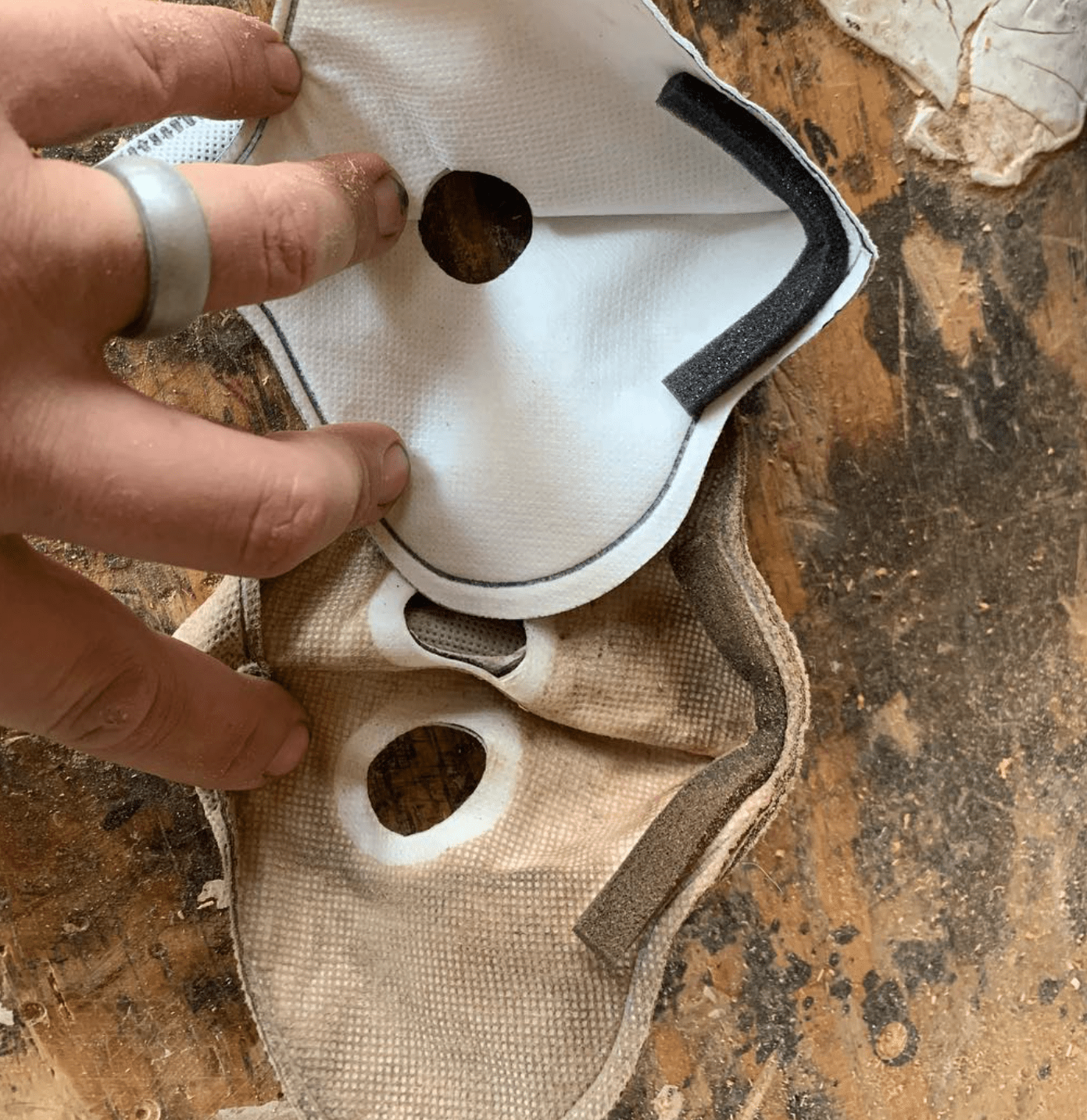
Stains, lacquers, polyurethane, shellac, and oil finishes release organic odors and VOCs during application and drying. These are not particulates — they are gaseous compounds that require active carbon filtration to address, not just particulate filtration. A mask without an active carbon element does not help reduce organic finishing odors. The RZ Mask F1 and F3 Active Carbon Filters include an active carbon layer specifically designed to help reduce these organic odors from wood finishing products during application.
Sawdust from Composite and Treated Materials
Pressure-treated lumber, painted wood, and composite decking materials can contain additional compounds beyond natural wood fiber. When cutting or sanding these materials, respiratory protection is especially important. Always work in well-ventilated areas when cutting treated or composite materials.
Why Particle Size Is the Critical Variable
The size of a dust particle determines how far into your respiratory system it can travel — and how much damage it can potentially cause with repeated exposure:
- Over 10 microns — trapped by nose and upper airway; irritating but largely cleared naturally
- 2.5–10 microns (PM10) — can reach the bronchial tubes; partially cleared but some retained
- Under 2.5 microns (PM2.5) — can penetrate deep into the lungs; difficult for the body to clear
- Under 1 micron — can reach the deepest lung tissue; very difficult to clear naturally
According to OSHA's wood dust guidelines, wood dust is a recognized occupational health hazard with established Permissible Exposure Limits (PELs). The CDC/NIOSH also provides guidance on wood dust exposure and respiratory protection for woodworkers.
RZ Mask F1 and F3 Active Carbon Filters are designed to filter particles down to 0.1 micron — capturing fine wood dust, MDF particles, and sanding dust at the sizes that matter most for respiratory health, well below the PM2.5 threshold.
What Filtration Does a Woodshop Mask Actually Need?
Given the range of particulates in a typical woodshop, an effective woodworking mask needs to address two distinct hazard types:
Particulate Filtration Down to 0.1 Micron
RZ Mask F1 and F3 Active Carbon Filters are designed to filter particles down to 0.1 microns — capturing fine wood dust, MDF particles, sanding dust, and other fine particulates at the sizes that matter most for respiratory health.
Active Carbon for Organic Odor Reduction
The active carbon layer in RZ Mask F1 and F3 filters is designed to help reduce organic odors from wood finishing products — stains, lacquers, polyurethane, and oil finishes — making finishing work more comfortable. Always ensure adequate ventilation in addition to wearing your mask during finishing operations.
Important: RZ Mask products are designed for general particulate filtration and organic odor reduction. They are not designed for protection against regulated hazardous substances including formaldehyde at occupational exposure levels, or other classified chemical hazards. For regulated workplace environments, consult your safety officer and applicable OSHA standards for appropriate certified PPE.
Best RZ Mask for Every Woodshop Task
For Most Woodshop Work: RZM3
The RZM3 premium reusable mask with F3 Active Carbon Filter is the definitive woodshop mask — filtration down to 0.1 micron, active carbon for finishing odors, no-fog design for safety glasses, three-strap fit for all-day shop wear, and dual discharge valves for breathability during physically demanding work.
For High-Exertion and Extended Sanding Sessions: RZ Airflow
For woodworkers who prioritize maximum breathability during long, physically demanding sanding and routing sessions, the RZ Airflow breathable mask is engineered for high-airflow comfort during active work.
For Professional Woodshop Environments with Compliance Requirements: RZ Pro FFP2 and FFP3
For professional woodshops, cabinet shops, and manufacturing environments where certified respiratory protection is required by regulation or employer policy, the RZ Pro FFP2 certified respirator and RZ Pro FFP3 certified respirator provide certified protection for compliance-driven environments. Consult your safety officer for guidance on your specific requirements.
The Right RZ Mask Setup for Every Woodshop Task
- Rough milling, tearing, crosscutting — RZM3 with F1 Active Carbon Filter; coarse and fine dust, active carbon for organic odors from the wood itself
- Sanding (power or hand) — RZM3 with F3 Active Carbon Filter; fine dust generation is highest during sanding; F3's improved breathability helps during extended sanding sessions
- Routing and shaping — RZM3 with F3 Active Carbon Filter; high-speed operations generate fine particles at high concentrations
- MDF cutting and routing — RZM3 with F3 Active Carbon Filter; fine MDF dust plus adhesive resin particles; active carbon helps with organic odors from resins
- Finishing — staining, lacquering, applying polyurethane — RZM3 with F3 Active Carbon Filter; active carbon designed to help reduce organic finishing odors; ensure adequate ventilation
- General shop cleanup — keep your mask on; sweeping and blowing down surfaces re-suspends fine dust that has settled, often generating higher airborne concentrations than the original cutting operation
Frequently Asked Questions: Woodshop Dust and Masks
How long does wood dust stay airborne after I stop cutting?
Fine wood dust particles — especially those under 4 microns — can remain airborne for 30 minutes or more after the tool stops. This is why keeping your mask on between tasks, and during cleanup, is as important as wearing it while cutting.
Is MDF dust more dangerous than solid wood dust?
MDF dust presents a compound challenge because it contains both wood fiber and adhesive resins. The dust is also extremely fine, generated at high concentrations during cutting and routing. Consistent respiratory protection is especially important when working with MDF regularly.
Do I need active carbon for woodworking if I don't do finishing?
Active carbon is most beneficial during finishing operations where organic odors from stains, lacquers, and finishes are present. For pure cutting and sanding without finishing products, a standard particulate filter provides the primary protection. However, most woodworkers do some finishing — and the F3 Active Carbon Filter handles both particulate filtration and organic odor reduction in one filter.
What's the best mask for sanding MDF?
The RZM3 with F3 Active Carbon Filter is designed for this task — filtration down to 0.1 micron for extremely fine MDF dust, active carbon to help reduce organic odors from adhesive resins, and F3 breathability for extended sanding sessions.
Should I wear a mask for hand tool woodworking?
Yes. Hand planes, chisels, card scrapers, and hand saws all generate fine dust that remains airborne for extended periods. The particle size from hand tool work is often finer than power tool dust — making it more likely to penetrate deep into the respiratory system. Wearing a mask during and after hand tool work is good practice.
When do I need a certified respirator in the woodshop?
For professional woodshops and manufacturing environments where certified respiratory protection is required by regulation or employer policy, the RZ Pro FFP2 or RZ Pro FFP3 certified respirators are the appropriate choice. For home workshops and general professional use, the RZM3 delivers excellent protection with superior comfort and breathability.
How often should I replace my woodshop mask filter?
Replace your RZ Mask filter when breathing resistance increases noticeably, when the filter becomes visibly soiled, or after extended use in high-dust environments. For active woodworkers doing regular sanding and routing, this typically means every 20–40 hours of shop time depending on dust levels and operations. Replacement filters are available directly from RZ Mask.
Breathe Smarter in the Shop.
Understanding what's in your shop air is the foundation of effective respiratory protection. Fine wood dust, MDF particles, and finishing odors are real hazards. A properly fitted mask with the right filtration is designed to help you address all of them.
RZ Mask has been protecting woodworkers, makers, and builders since 2010. Explore the full lineup: the RZM3 premium reusable mask, the RZ Airflow comfort-focused mask, the RZ Pro FFP2 certified respirator, and the RZ Pro FFP3 certified respirator.
For wood dust exposure guidelines, visit OSHA Wood Dust and CDC/NIOSH Wood Dust. RZ Mask products are designed for general particulate filtration and organic odor reduction — not for regulated hazardous substance protection. Consult your safety officer for workplace-specific PPE requirements.







EUROPE, BREATHE EASIER, WORK SAFER: Unleashing the Power of RZ Mask FFP2 & FFP3
RZM3 FFP2 Certified Respirator: A New Age of Air Filtration