
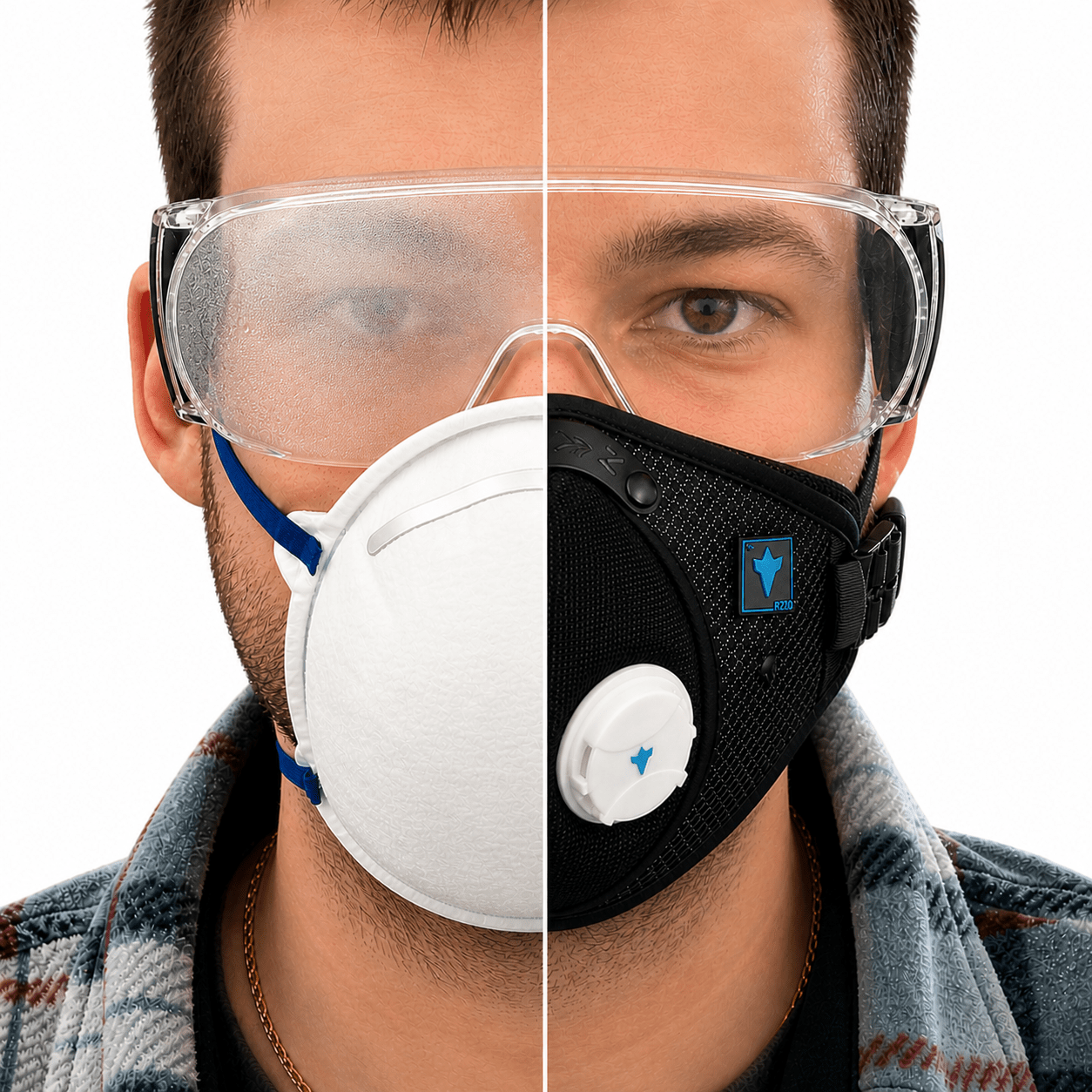
Why Your Mask Fogs Your Safety Glasses — And How to Stop It for Good
You put on your dust mask. You pick up your safety glasses. Within sixty seconds, your lenses are fogged and you can't see what you're doing. So you pull the mask down. And the moment you do, you're breathing unfiltered air in exactly the environment where you need protection most.
This is one of the most common — and most dangerous — failure points in workplace and workshop respiratory protection. Fogged lenses aren't just an inconvenience. They're a genuine safety hazard that causes workers to remove their masks at the worst possible moment. And the frustrating part is that it's entirely preventable — when your mask is engineered correctly.
This guide explains exactly why masks fog your glasses, what it takes to actually prevent it, and how the RZM3 premium reusable mask is designed to keep your vision clear and your lungs protected — at the same time.
The Real Reason Your Mask Fogs Your Glasses
Fogging is a physics problem. Warm, moist exhaled air escapes upward from the top of your mask and contacts the cooler surface of your lenses. The moisture condenses — exactly like a bathroom mirror after a hot shower — and your vision disappears. It happens faster in cold weather, during physical exertion, and whenever your mask doesn't seal properly against your face.
There are two root causes. A properly designed mask must address both — or fogging will continue regardless of how carefully you fit it.
Root Cause 1: A Gap at the Nose Bridge
The most common cause of fogging is a gap between the mask and the bridge of your nose. Most paper dust masks and disposable respirators include a thin metal strip at the nose that bends to approximate your nose shape — but doesn't create a true, complete seal. That gap becomes a channel that directs warm exhaled breath straight upward into the space behind your glasses or goggles. Every breath out sends a pulse of warm, moist air directly at your lenses.
The fix isn't bending the strip harder. The fix is a proper adjustable nose clip that conforms to the specific shape of your nose bridge and creates a complete seal — not an approximation of one.
Root Cause 2: No Active Exhaust System
Even with a reasonable nose seal, exhaled air has to go somewhere. Masks with no discharge valves allow warm, moist exhaled air to build up inside the mask until pressure forces it out through whatever gaps exist — including upward toward your lenses. These masks also trap heat and moisture inside, making the interior progressively warmer and more humid over time. The longer you wear them, the worse the fogging gets.
The fix is active one-way discharge valves that exhaust warm, moist exhaled air downward and away from your face with every single breath out — before it can reach your lenses.
What a Genuinely Fog-Free Mask Requires
Two things, working together. Neither one alone is enough.
A True Adjustable Nose Clip
Every RZ Mask product includes an adjustable nose clip engineered to be shaped precisely to your individual nose profile — not a generic approximation. Properly fitted, it creates a complete seal across the full width of your nose bridge that holds through movement, bending, lifting, and extended wear. It directs every exhaled breath downward and out through the discharge valves — not upward into your lenses.
Fitting the nose clip correctly is the single most important step in fog-free mask performance. Take thirty seconds to shape it carefully to your nose. It makes the difference between a mask that fogs and one that doesn't.
Dual One-Way Discharge Valves
Every RZ Mask product includes dual one-way discharge valves that actively exhaust warm, moist exhaled air downward and away from your face with every breath out. On inhale, the valves close — all incoming air passes through the filter. On exhale, the valves open — warm, moist air exits away from your face before it can reach your lenses.
Dual valves provide more exhaust capacity than a single valve — more effectively removing heat and moisture from inside the mask with each breath. The result is a mask interior that stays cooler and drier than masks without discharge valves, delivering better fog-free performance and significantly greater all-day comfort.
How the RZ Mask Fog-Free System Works
- You inhale — discharge valves close; all incoming air passes through the filter. Clean, filtered air enters your airways.
- You exhale — discharge valves open; warm, moist exhaled air exits downward and away from your face. The nose clip seal prevents upward escape toward your lenses.
- Result — exhaled air never reaches your lenses. Fogging is significantly reduced compared to masks without a proper nose seal and active discharge valves. And the mask interior stays cooler and drier for all-day comfort.
This isn't a workaround. It's an engineered system. And it's why workers who switch to the RZM3 consistently report that they stop pulling their mask down — because they can finally see and breathe at the same time.
Who Needs a Fog-Free Mask Most
Woodworkers and Furniture Builders
Safety glasses are non-negotiable at the table saw, router table, and lathe. A mask that fogs your glasses forces an impossible choice: vision or respiratory protection. With the RZM3 three-strap reusable mask, you don't have to choose. You get both — all day, every day in the shop.
Construction and Trades Workers
Safety glasses on the job site are required PPE. A mask that fogs them doesn't just create frustration — it creates a genuine safety hazard when you're operating power tools, working at height, or navigating an active job site. The RZM3's fog-free system keeps your lenses clear through a full shift of physical work.
ATV and UTV Riders
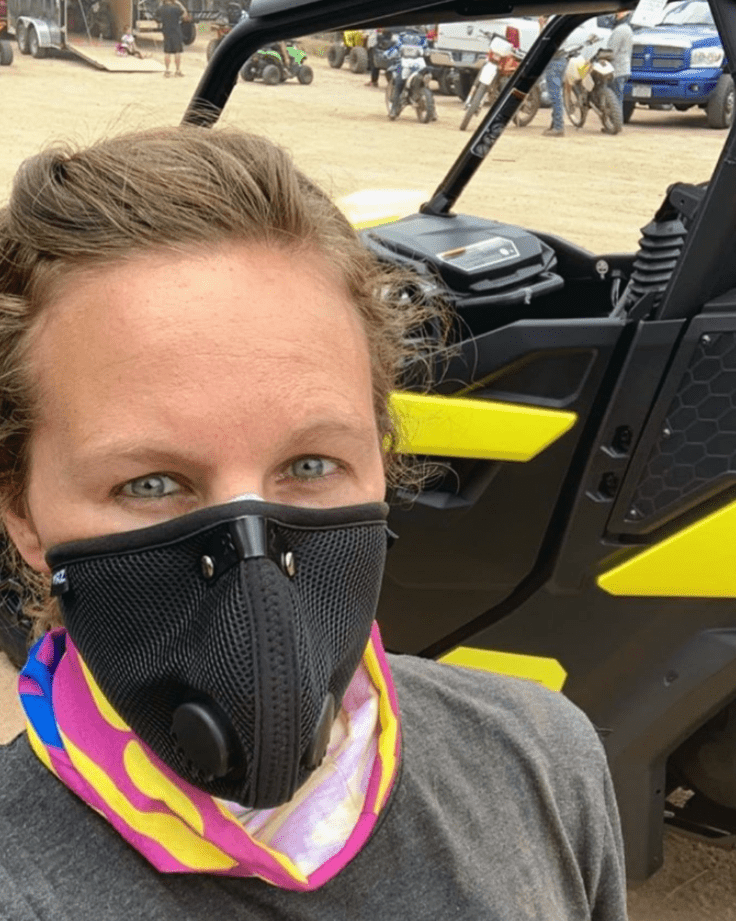
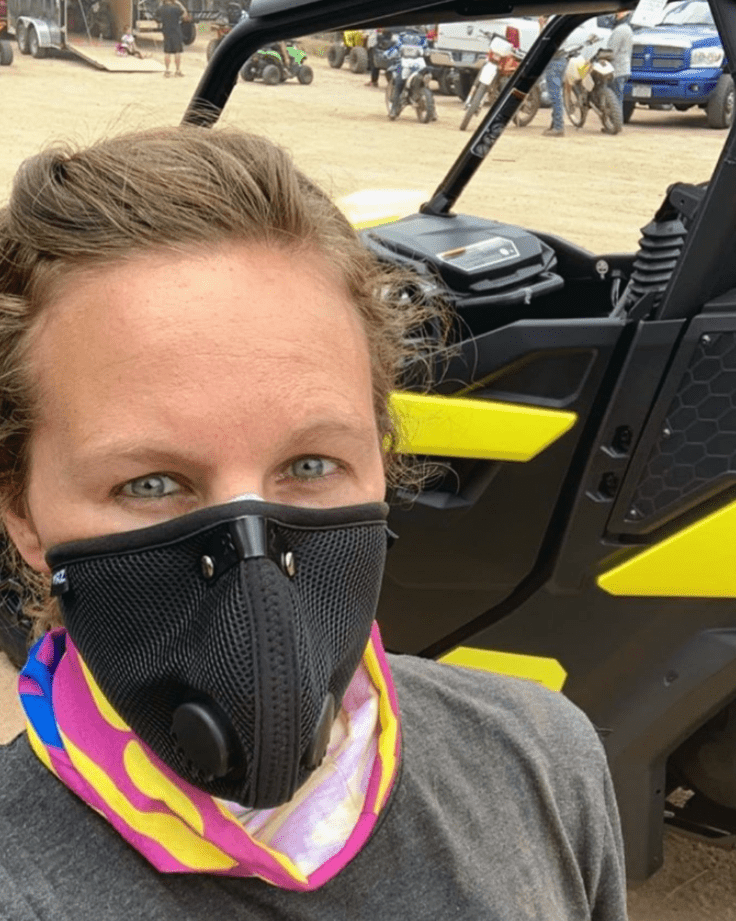
Fogged goggles at speed are dangerous. Full stop. The RZM3's adjustable nose clip and dual discharge valves are designed to keep riding goggles clear through active, high-exertion riding — including in cold weather where fogging is most severe. The three-strap system stays stable at speed and adapts to helmets and cold-weather headgear.
Cold-Weather Outdoor Workers
Fogging is worst in cold conditions — the temperature differential between warm exhaled breath and cold lens surfaces is greatest in winter. This is exactly where the RZ Mask fog-free system delivers its most meaningful advantage. The nose clip and dual discharge valves are designed to perform in all temperature conditions encountered in normal outdoor and work environments.
Prescription Glasses Wearers
Prescription glasses fog just as easily as safety glasses. For everyday mask wearers who also wear prescription eyewear, the fog-free design is a quality-of-life improvement that makes wearing a mask consistently — and correctly — far more practical.
Best RZ Mask for Fog-Free Performance with Safety Glasses and Goggles
For most users — woodworkers, construction workers, powersports riders, and outdoor workers — the RZM3 premium reusable mask is the definitive fog-free choice. Its patented three-strap system provides the most stable, secure fit in the lineup — and fit stability is directly tied to nose seal quality, which is directly tied to fog-free performance. Better fit means better seal. Better seal means less fogging.
For high-exertion users who prioritize maximum airflow — cyclists, runners, and active outdoor workers — the RZ Airflow breathable mask delivers the same fog-free system in a comfort-focused, high-airflow design built for aerobic activity.
For professional environments where certified respiratory protection is required alongside fog-free performance, the RZ Pro FFP2 certified respirator and RZ Pro FFP3 certified respirator provide certified protection with the same commitment to fit, seal quality, and fog-free design.
Five Tips for Maximum Fog-Free Performance
- Fit the nose clip first, every time — press it firmly against the bridge of your nose and shape it precisely to your nose profile before putting on your glasses or goggles. This is the single most impactful step.
- Position the mask high on your face — the top edge of the mask should sit close to the bottom of your glasses or goggle frame, minimizing the gap through which exhaled air could escape.
- Check the full perimeter seal — run your finger around the complete edge of the mask to confirm it's making full contact with your face. Any gap is a potential fogging pathway.
- Keep discharge valves clean and clear — check periodically that the valves are opening and closing freely. Debris or damage reduces exhaust effectiveness and increases fogging risk.
- Replace filters before they clog — a clogged filter increases exhaled air pressure inside the mask, forcing air through gaps and increasing fogging. Replace when breathing resistance increases noticeably.
Frequently Asked Questions: Fog-Free Masks for Safety Glasses
Why does my current dust mask fog my glasses no matter what I do?
If you're experiencing persistent fogging despite careful fitting, the most likely cause is that your mask lacks one or both of the key fog-free components: a proper adjustable nose clip that creates a complete seal, and active discharge valves that exhaust exhaled air away from your face. Standard paper masks and many disposable respirators don't include either. Switching to a mask with both — like the RZM3 — addresses the root causes rather than working around them.
Does the RZ Mask completely eliminate fogging?
The RZM3's adjustable nose clip and dual discharge valves are designed to significantly reduce fogging compared to masks without these features. Proper fitting of the nose clip is essential — a correctly fitted RZ Mask nose clip directs exhaled air downward and away from your lenses. Individual results may vary based on face shape, glasses frame style, and fit precision.
Which RZ Mask is best for wearing with safety glasses all day?
The RZM3 is the top choice for all-day safety glass wearers. Its three-strap system maintains a stable, consistent fit through a full day of physical work — which directly supports the nose seal quality that drives fog-free performance. For high-exertion use, the RZ Airflow is a strong breathability-focused alternative.
Can I wear an RZ Mask with riding goggles for ATV or UTV use?
Yes. RZ Mask products are designed to be compatible with riding goggles. The adjustable nose clip creates a seal that works with goggle frames, and the dual discharge valves actively exhaust exhaled air away from the goggle lens surface. Fit the nose clip carefully and position the mask high on your face for best fog-free performance with goggles.
Is the fog-free design more important in cold weather?
Yes. Cold weather makes goggle and glasses fogging significantly more severe — the temperature differential between warm exhaled breath and cold lens surfaces is greatest in winter. The RZ Mask nose clip and discharge valve system is designed to work in all temperature conditions, and its fog-free advantage is most pronounced in cold-weather environments.
When should I choose a certified respirator over the RZM3 for fog-free protection?
If your work environment requires certified respiratory protection by regulation or employer policy, the RZ Pro FFP2 or RZ Pro FFP3 certified respirators are the appropriate choice. Both maintain the same fog-free design principles. For general work, workshop, and recreational use, the RZM3 delivers superior comfort, breathability, and fog-free performance.
See Clearly. Breathe Better. Every Single Day.
The choice between clear vision and respiratory protection shouldn't exist. It only exists when your mask isn't engineered to prevent it. The RZM3 breathable reusable mask is built so you never have to make that trade-off — in the woodshop, on the job site, on the trail, or anywhere else you need both.
Stop pulling your mask down to see what you're doing. Explore the full RZ Mask lineup: the RZM3 premium reusable mask, the RZ Airflow comfort-focused mask, the RZ Pro FFP2 certified respirator, and the RZ Pro FFP3 certified respirator.
For workplace eye protection standards, visit OSHA Eye and Face Protection. RZ Mask products are designed for general particulate filtration and organic odor reduction.





What Is the Best Mask for Woodworking? The Complete Guide to Wood Dust Respiratory Protection
PTAC Air Purifier: What It Is, How It Works, and Why Your Building Needs One